
After years of service in demanding applications, the T450E Series is being succeeded by a new generation: the BT1 Temperature Transmitter. The BT1 keeps the purpose that made the T450E useful: reliable temperature data in harsh and hazardous environments. It also expands what that measurement can handle. Here is what the new Transmitter is, what has changed, and what each upgrade means in practice.
What is a temperature transmitter, and what does the BT1 do?
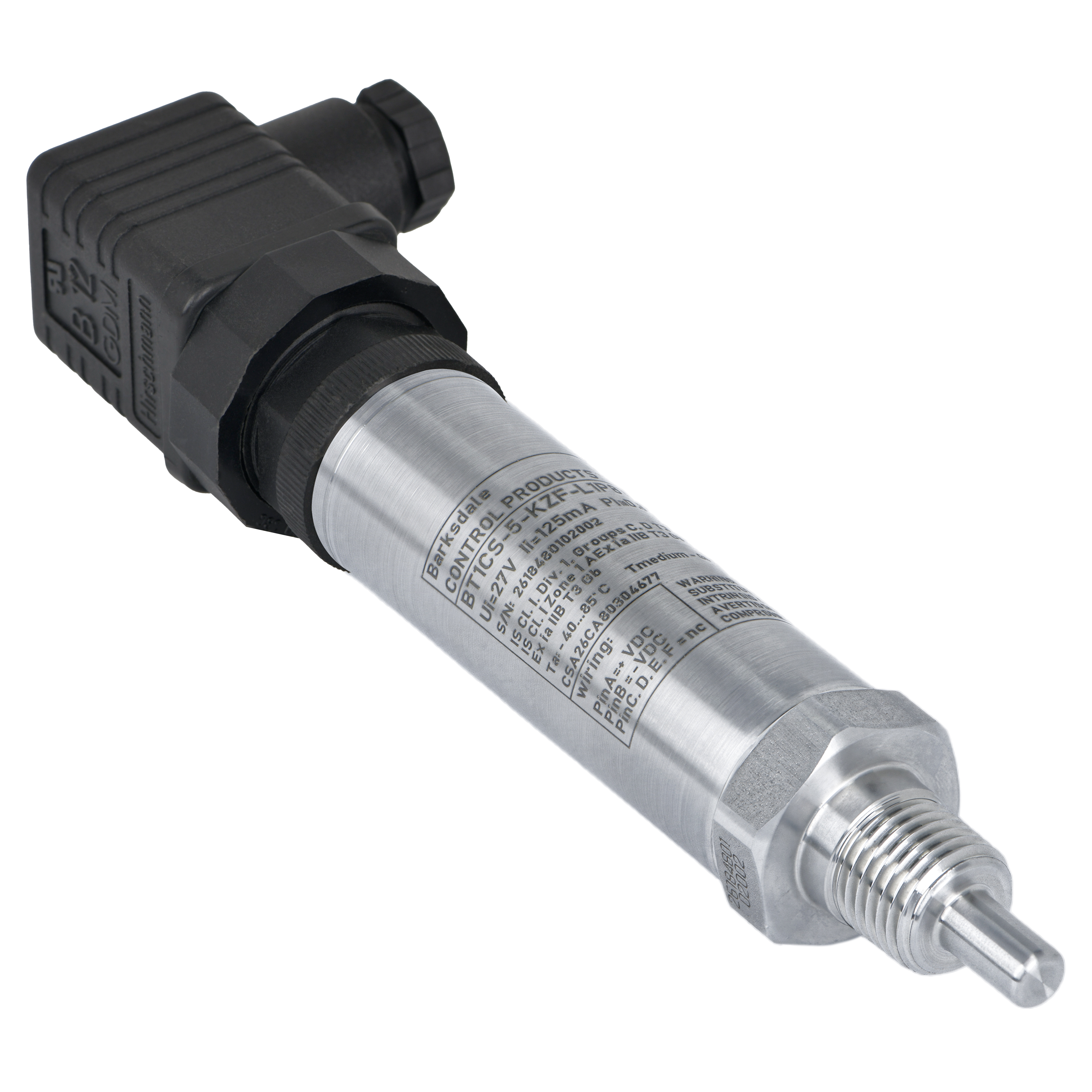
A temperature transmitter takes the small signal from a sensing element and converts it into a standardized output that a controller can read directly. That turns a raw sensor reading into usable process information.
This model combines a PT100 sensing element and the transmitter electronics in one compact 316 stainless-steel body. It delivers temperature changes in 4–20 mA, voltage, or 0.5–4.5 V ratiometric formats. It mounts directly into the process, so a single device handles both sensing and signal conversion.
The unit is built for hydraulic systems, oil and gas equipment, compressors, and other environments where temperature data has to hold up under pressure, vibration, and heat.
Why is the BT1 an upgrade over the T450E?
The new model extends the T450E’s capabilities in six areas.
1. Hydrogen media compatibility
The configurator includes dedicated hydrogen-application versions under CSA and ATEX, alongside the standard versions.
Anyone designing hydrogen compressors, refueling stations, or fuel-cell systems can specify a transmitter configured for hydrogen service from the start. This capability is new to the series.
2. Extended temperature range
The BT1 measures media up to 200°C (392°F), up from 150°C on the T450E. The ambient rating for the electronics also rises to 85°C.
The most valuable measurement points are often the hottest ones, such as compressor discharge, hydraulic return lines, and fluid near heat sources. A higher rating means the measurement can go where the information matters most.
3. Robust mechanical construction
This next-generation model is rated to 20 g across three axes (EN/IEC 60068-2-6), double the 10 g rating of the T450E.
On fracking trucks, mobile hydraulics, and heavy equipment, vibration never stops. The added margin supports mounting on pumps, manifolds, and engine-adjacent blocks. As with any specification, it should be checked against the actual vibration profile of the application.
4. Hazardous location approvals
This Transmitter carries CSA, ATEX, and IECEx approvals, with intrinsically safe options for hazardous locations.
CSA is widely specified across North American oil and gas. This helps equipment for wellheads, BOP systems, and gas compression to move through certification and procurement. Approval availability varies by output type, so each configuration should be confirmed for its intended installation.
5. Custom process connections
Our Temperature Transmitter adds 7/16"-20 UNF and 9/16"-18 UNF process connections to the 1/4"-18 NPT and G1/4 options.
UNF ports are common on hydraulic manifolds and power units. Threading the transmitter directly into an existing port removes adapters. That means fewer potential leak points, fewer part numbers, and fewer assembly steps.
6. Improved response time
The BT1 lists a response time under 2 ms and long-term stability of ±0.1% FS per year under reference conditions.
A published stability figure gives engineers a number to plan around when setting calibration intervals or relying on temperature trends for maintenance decisions. Fast electrical response supports data acquisition and high-cycle equipment.
Using the T450E today? Here’s how to move to the BT1
Existing T450E installations don’t need to change overnight. Planning the move now keeps new builds and replacements on the current series. A few practical points:
- Signals are familiar. The BT1 offers 4–20 mA, voltage, and 0.5–4.5 V ratiometric outputs, which cover the same signal types as the T455E, T452E, and T454E.
- Special options need review. If your current T450E uses options such as oxygen cleaning, NACE compliance, or a specific connector, our team can help you identify the matching BT1 configuration. If you have a custom requirement, please consult the factory.
Plan your transition to the BT1
Talk with the Barksdale team about the right BT1 configuration for a new design or an existing T450E application.